
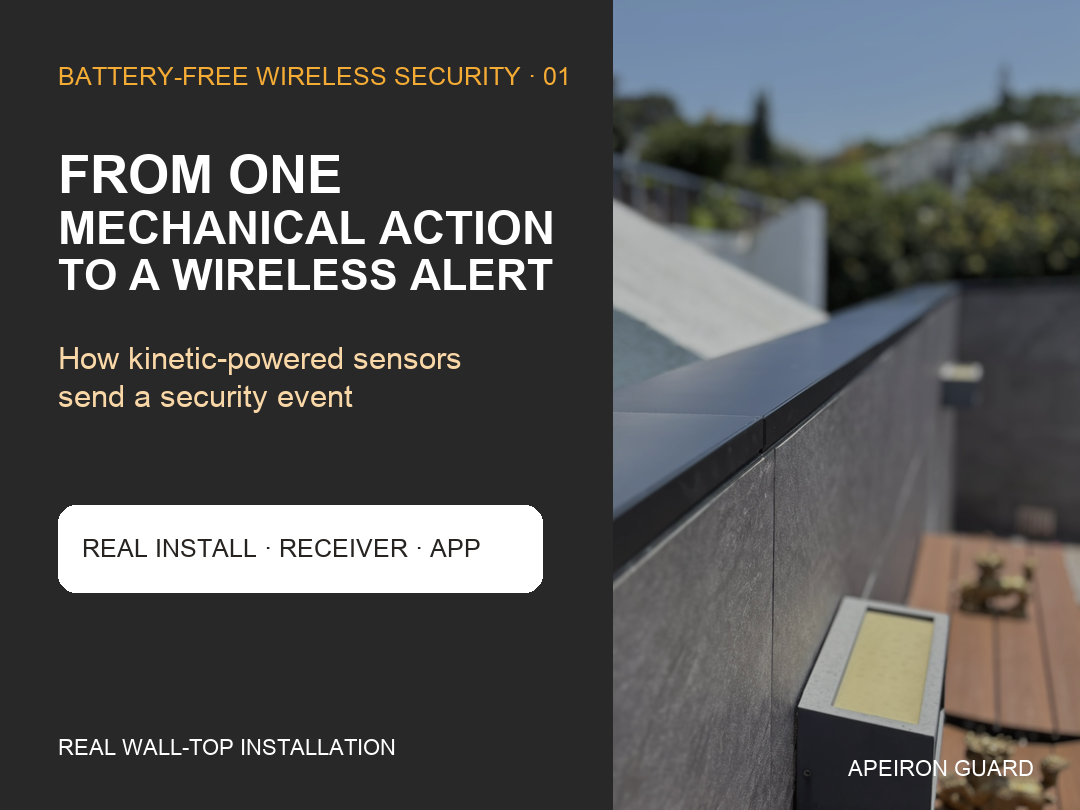
The event itself supplies the transmission energy
When a door opens, a perimeter point is pressed or a protected object moves, the defined mechanical action can be converted into a brief electrical pulse. Low-power electronics use that pulse to encode and transmit a short event message.
This is event-powered sensing, not perpetual power. It does not imply continuous energy generation, continuous telemetry or unlimited radio performance. The internal conversion mechanism is product-specific and is not inferred from installation photographs.
One event, five linked steps
1. A defined mechanical action occurs
Opening, pressure or movement activates the sensor mechanism at the protection point.
2. The action produces a brief electrical pulse
The pulse is designed to supply the energy needed for that event, not ongoing electronics.
3. Low-power electronics encode and transmit
The field device sends a short wireless event signal.
4. A powered receiver listens
The Mini Alarm Hub or Wireless I/O Module receives the event, subject to compatible configuration and a verified radio path.
5. The system creates the selected response
The powered route can activate a local alarm and app notification, or pass an event through dry-contact integration to a compatible system. Not every route provides every response.
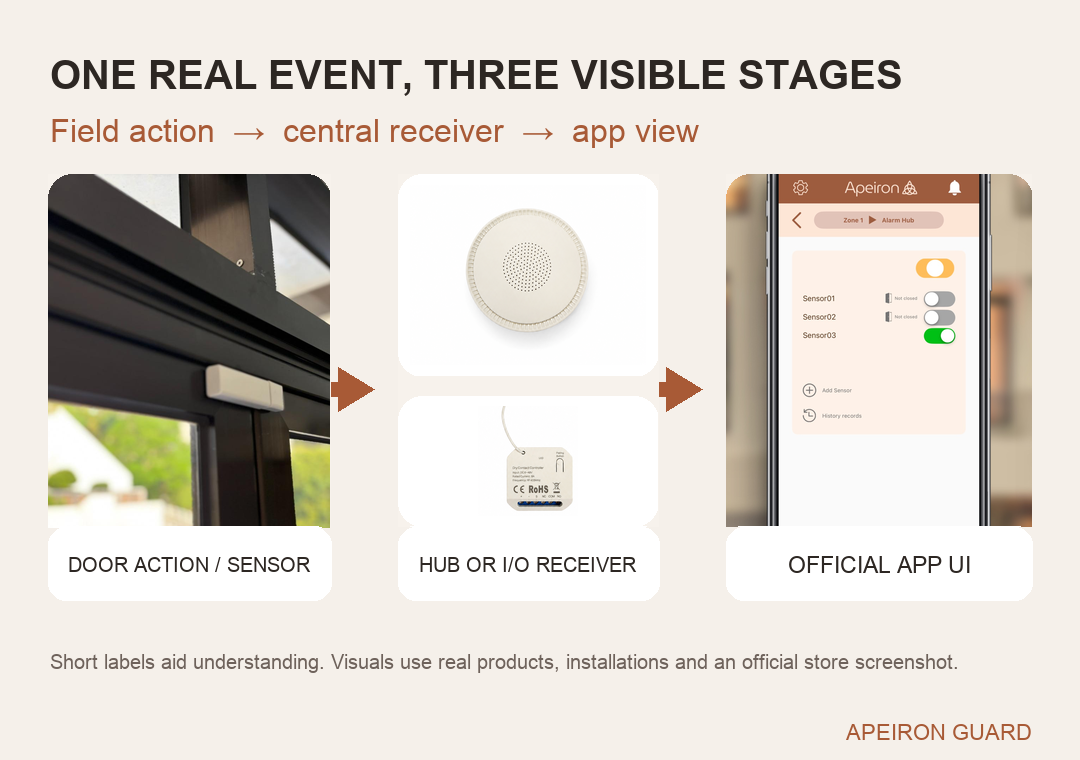
Battery-free applies to field sensors, not the complete system
Apeiron Guard field sensors are distributed at doors, windows, walls, fences, glass balustrades or protected objects. Removing a battery from those points can reduce recurring field service. The central receiver, networking equipment and connected alarm response remain powered.
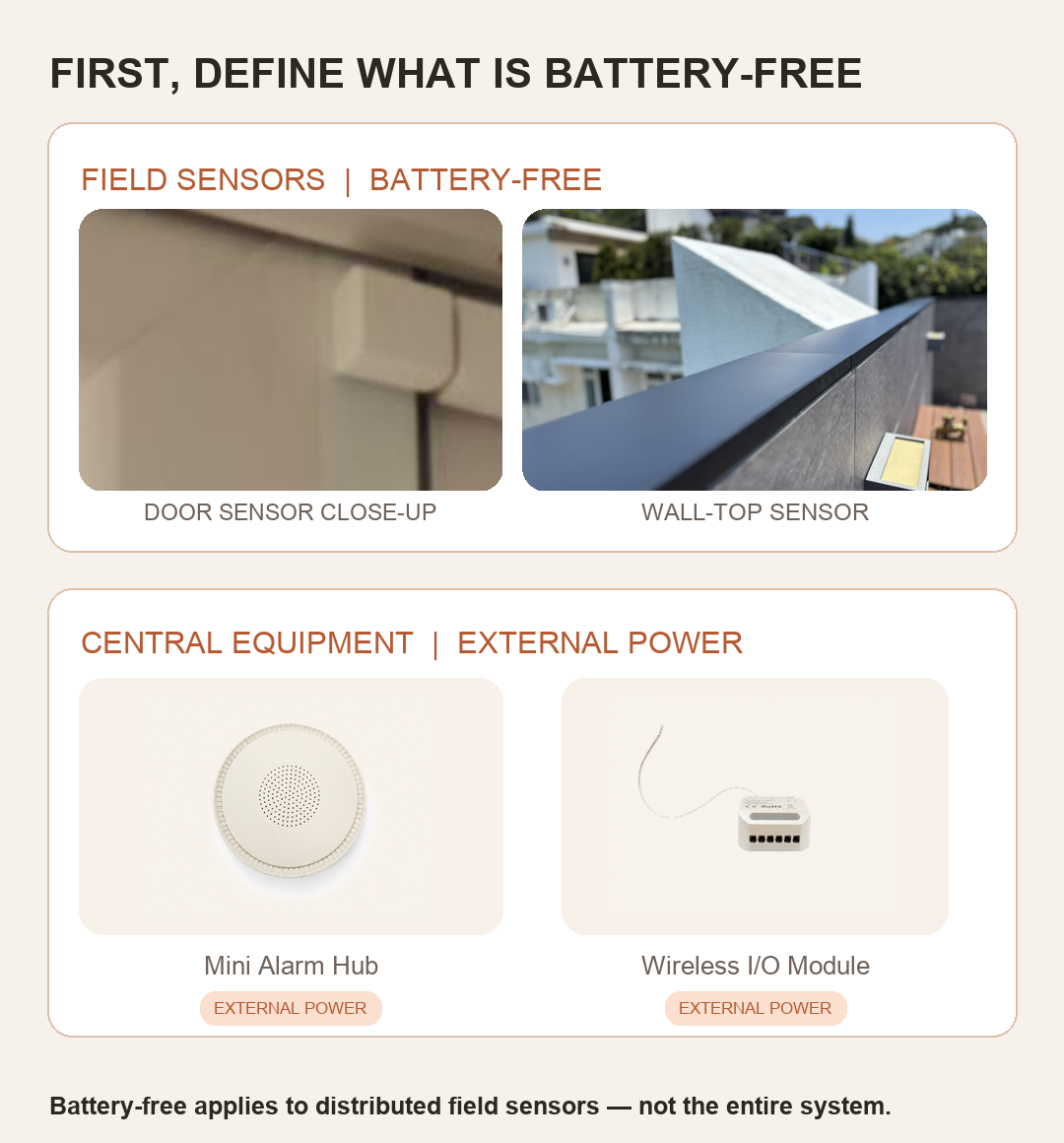
Wired, battery wireless and kinetic-powered all have a place
Wired systems can be the strongest choice where routes and power are planned. Battery-powered wireless devices can support continuous electronics, scheduled status reporting, processing or frequent communication, depending on model design. Kinetic-powered sensing is strongest where an event has a clear mechanical action and avoiding distributed batteries or new field wiring is valuable.
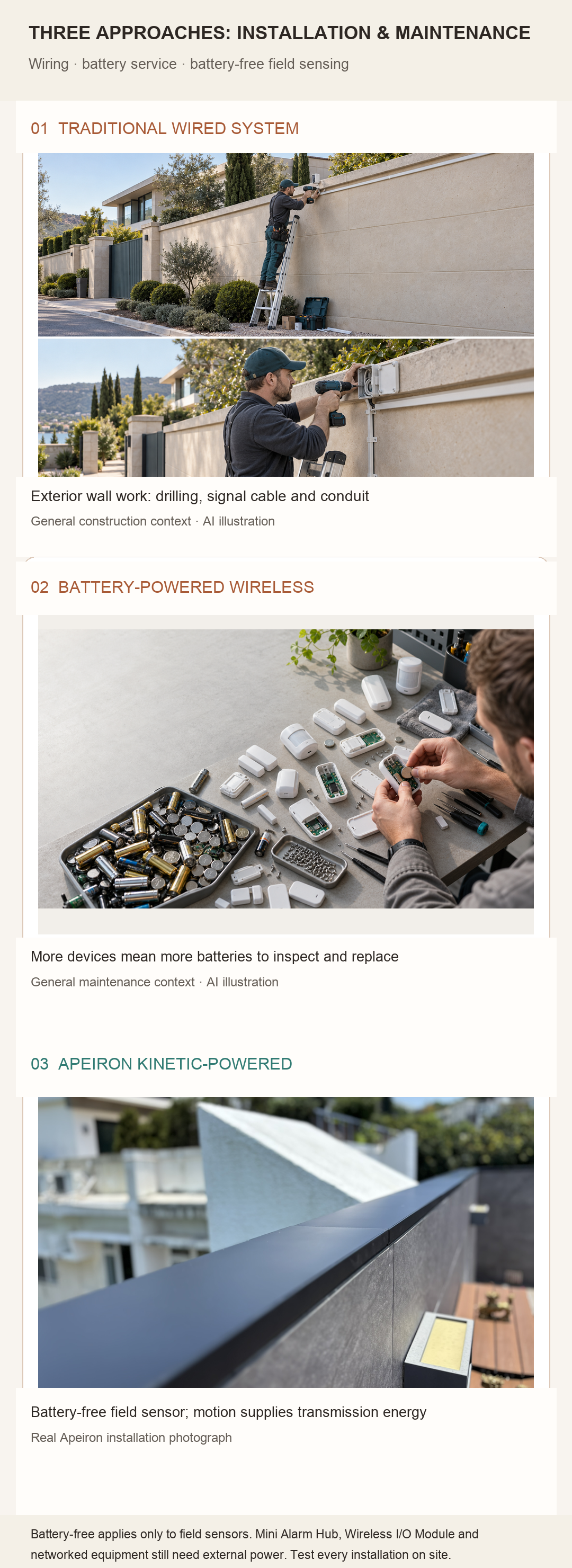
What engineering acceptance still has to prove
The objective is not to produce a large amount of electricity. It is to generate enough energy, consistently, for a low-power event transmission. Mechanical travel and force must trigger reliably; encoding and transmission must complete within the available pulse; and the receiver must be placed within a radio path verified at the actual site.
Approved source material cites durability testing above 100,000 operations and IP55 protection. Those statements are not a warranty of service years, universal RF range or immunity from inspection. IP55 is dust-protected and resistant to water jets; it is not dust-tight or immersion-proof. Use current model documentation and test the final mounting, seams, travel, force, receiver and alarm response.
Common questions
Does battery-free mean the whole alarm system needs no power?
No. It applies to the field sensor. Receivers, networking and alarm-response equipment still require power.
Does the sensor generate power continuously?
No. A defined mechanical event produces brief energy for an event transmission.
Does the field sensor connect directly to Wi-Fi or the app?
No direct connection is implied. A compatible powered receiver handles the selected alarm, app or dry-contact integration route.
Can the installation skip commissioning and maintenance?
No. The mechanism, mounting, radio path, receiver and final response require site testing and periodic inspection.
Evaluating a real protection point?
Share the event, mounting surface, access conditions and required alarm response.